● Free with ads · $9.99 to remove them● Your data stays on your device
One app, from first tomato to full homestead.
From the first seed to what ends up on the table — growing, animals, land and water, what to watch for, and what to do with the harvest. Plus built-in reference guides: a plant catalog, poultry and livestock breed guides, a mushroom guide, and sourced ways to use what you pick. Every entry sourced, and every one works offline.
1,300+ plants3,200+ varieties300+ animal breeds199 preservation methods178 crops with nutrition data
Built for the path from your first tomato bed to a full kitchen garden.
Bees, hens, ducks, goats — whatever you raise, in one logbook.
The infrastructure layer — your yard, your beds, your irrigation lines.
What's headed your way, before it hits.
What happens after the picking — keeping it, using it, and knowing what's in it.
The business side of the homestead — money, records, and what's next.
Local-first, multi-device, never locked in.
Plants & gardening
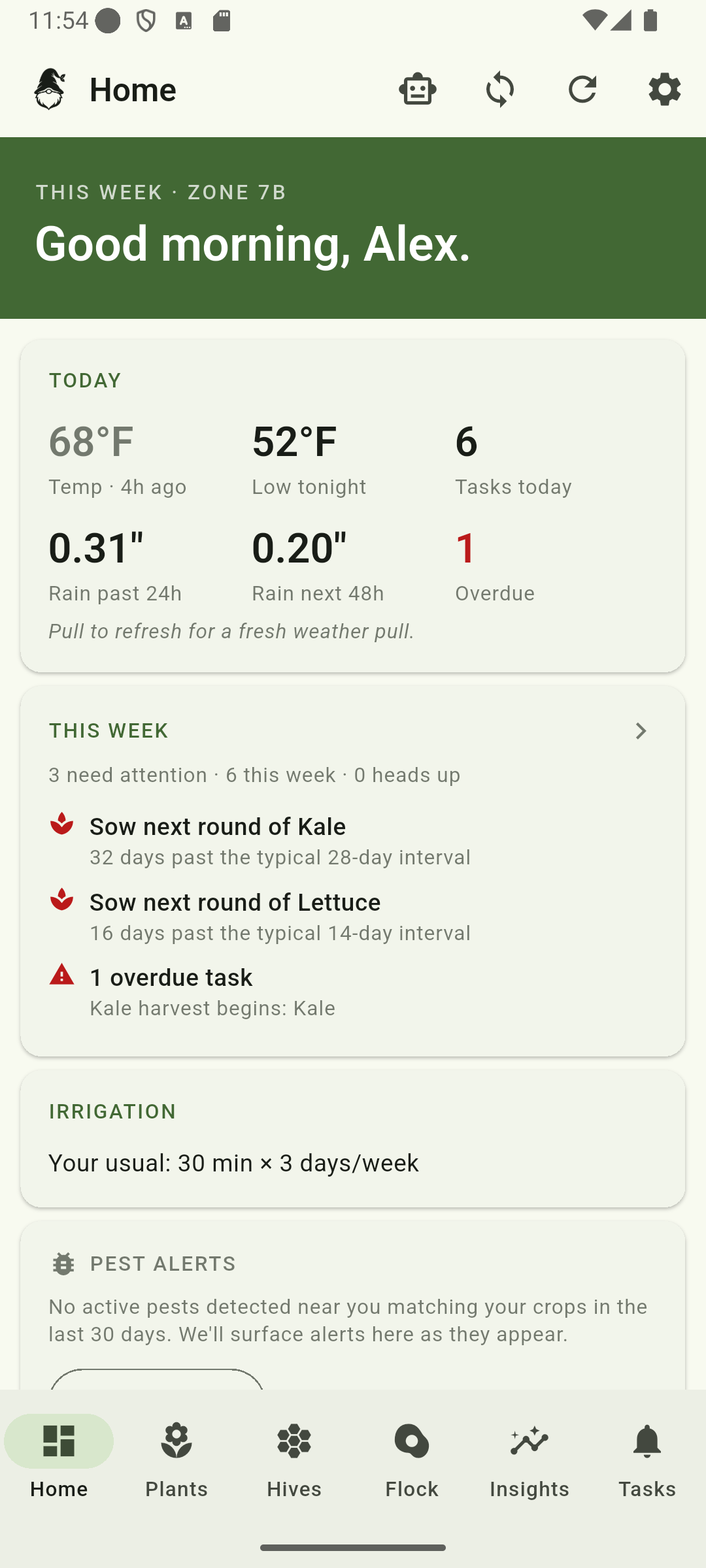
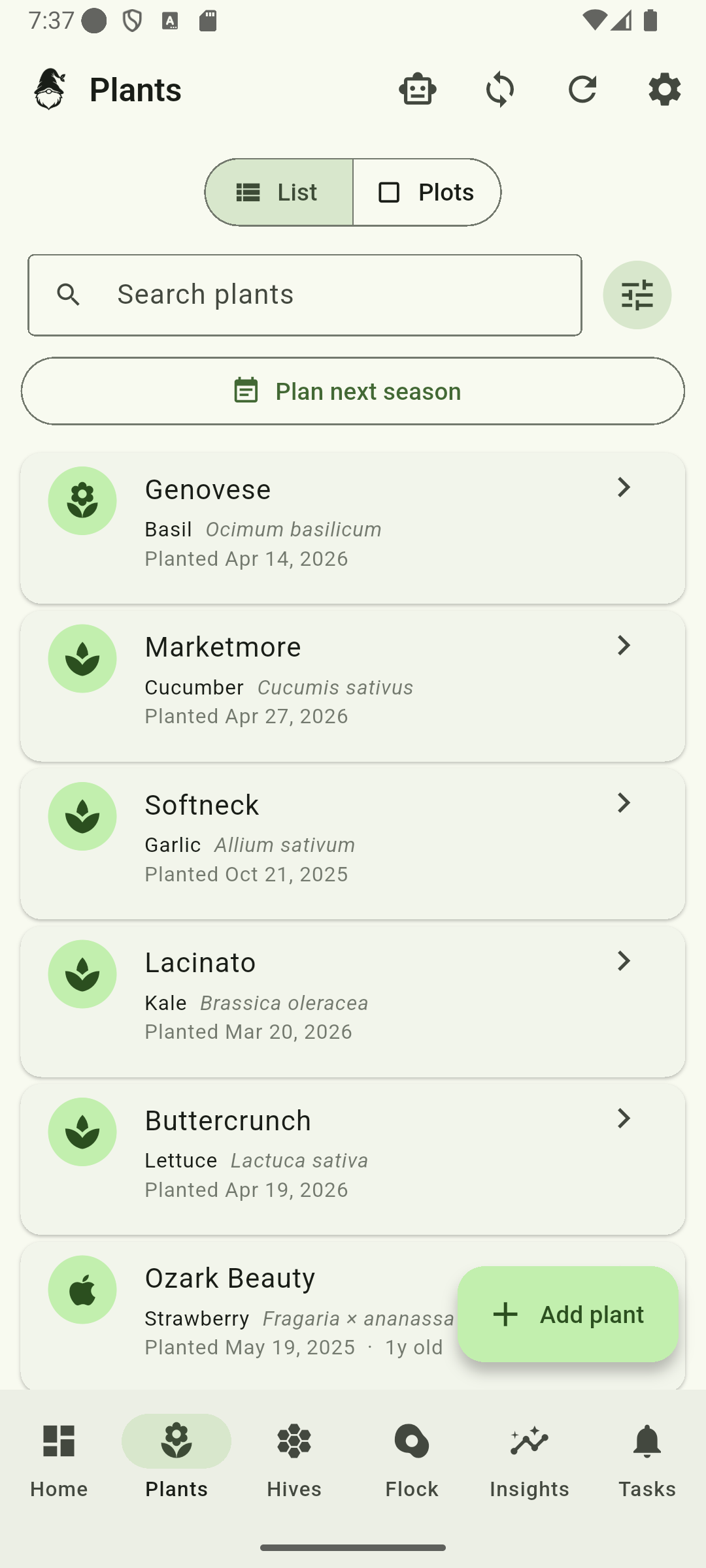
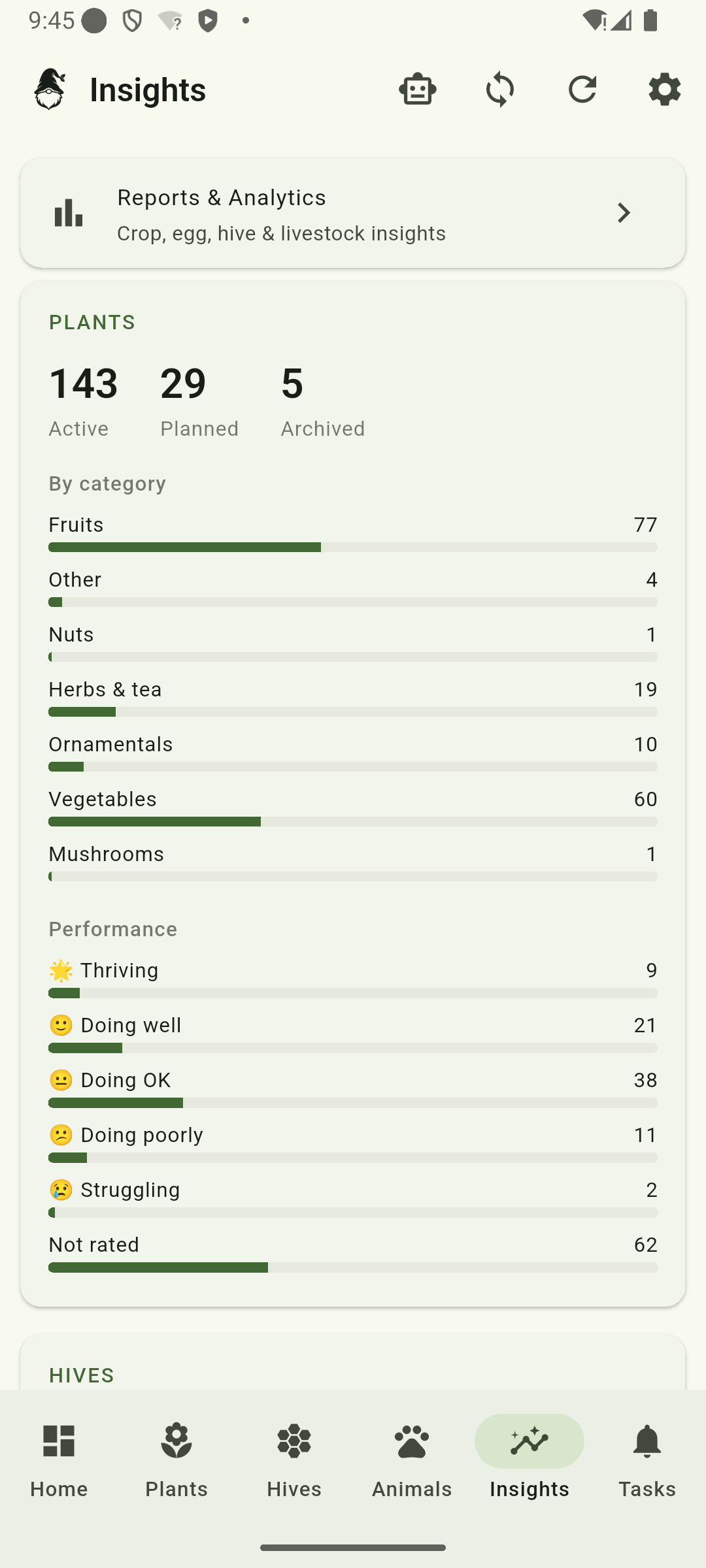
Start from 1,300+ plants with zone, sun and days-to-maturity, so you pick from a rich list instead of typing from scratch. Frost-relative scheduling, spring and fall windows, variety-level tracking, performance ratings, and per-variety notes help you grow what fits your garden and table. Each planting records how it's grown (in soil, under cover, or in a hydroponic or aquaponic system) and the timing and care advice follow.
Mushrooms
Grow gourmet mushrooms on logs, blocks, or beds: ten species from oyster and shiitake to lion's mane and chestnut. Track inoculation, spawn run, and fruiting, and log each flush's yield right alongside your plants.
Planning ahead
Suggest a plot recommends crop-family-safe picks for each open bed and flags picks that are already too late for the season. Nursery tracks anything started indoors or by cutting until it's ready to go in the ground. And once a fast-turnover crop like lettuce or beans is in, the engine schedules the next sowing so your harvest never gaps out.
Compost
Track every bin with its own method (tumbler, hot pile, standard, cold, vermicompost). Turn-and-moisture reminders fire on the right cadence; hot piles get a 130–160°F temperature tracker.
Plant ID camera
Point your camera in-app and PlantNet returns a species match. Or sync cultivated iNaturalist observations as candidate plantings ready to confirm.
Soil tests & fertilizer
Enter your extension lab's NPK + pH and GardenKnowm produces crop-specific, bed-aware recommendations using NC State, Cornell & Penn State amendment math.
Bees
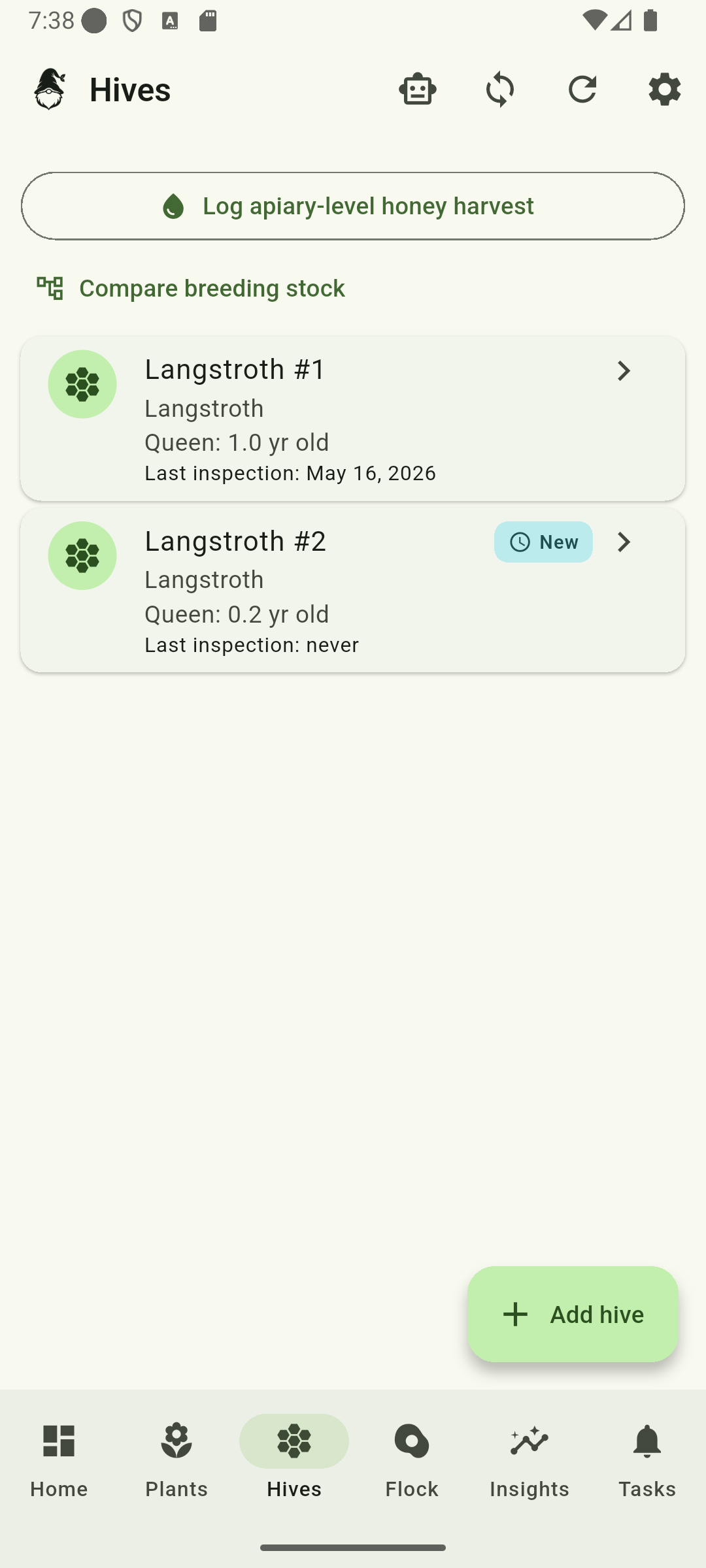
Langstroth, top-bar, Warré, Flow, each tracked in its own equipment (box stack, frame or bar sizes). Per-queen records through supersedure, mite counts and treatments, honey harvests with brix and moisture. Winter readiness scored against a stores target for your latitude, plus printable QR hive tags.
Poultry
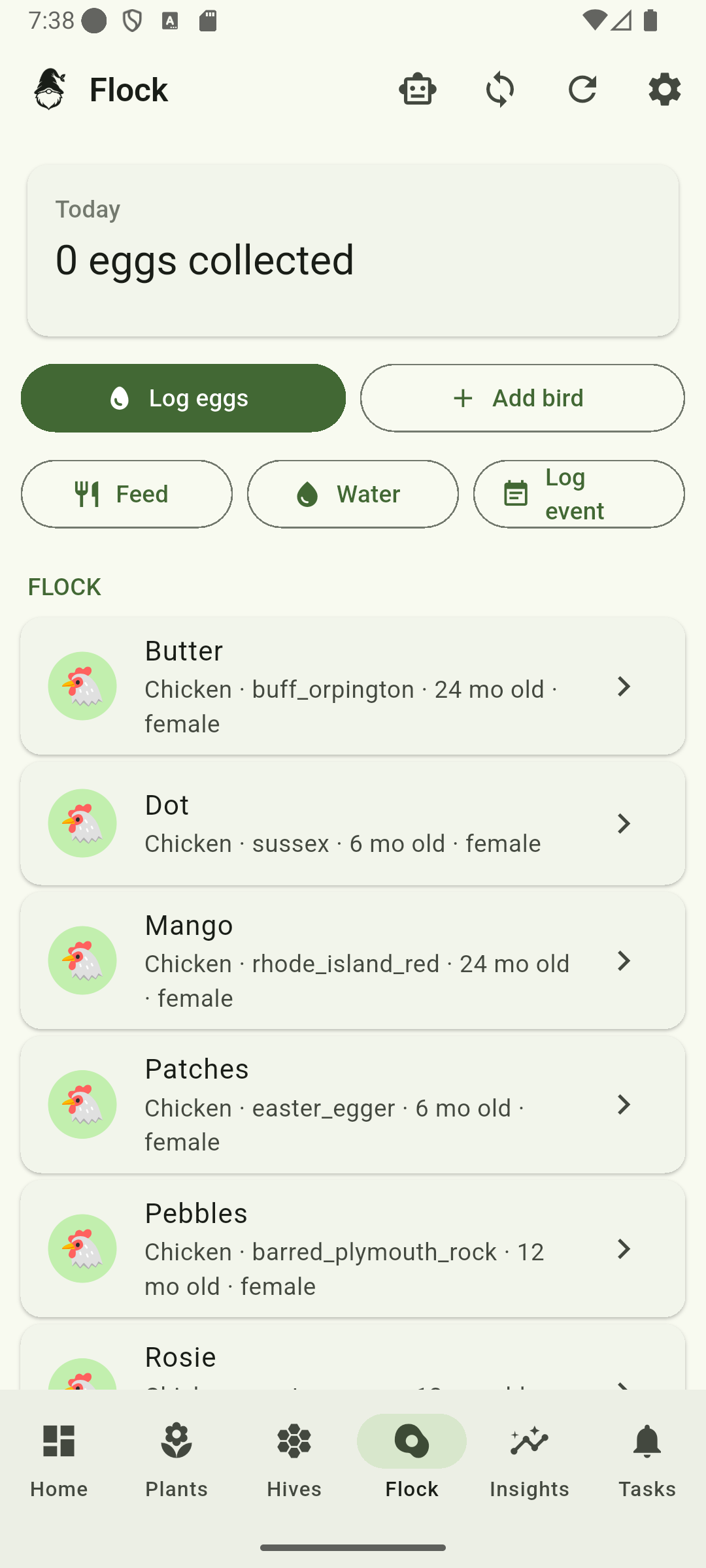
Chickens, ducks, geese, quail, turkeys, guinea fowl, backed by a sourced breed guide to help you pick the right birds. Log eggs by individual bird (for show breeders) or whole flock (the realistic default). Reminders adapt to how often you log.
Livestock
Goats, sheep, pigs, cattle, rabbits, with a sourced breed guide spanning all five species and the right registration fields per animal: scrapie tags for sheep, ear notches for pigs, ARBA numbers for rabbits. Bulk-add a litter when one record per animal isn't worth it.
Plots & property mapping
Draw plots on a satellite map, anchor them to GPS, attach photos and soil tests to the specific bed they came from. The fertilizer advisor's recs go bed-aware, not yard-wide.
Crop rotation
A heads-up before you plant, not after: if a bed grew the same crop family recently enough that a rest period is still advised — nightshades, brassicas, cucurbits, alliums and more — you'll get warned ahead of your typical planting time, and again if you assign the plot anyway. Covers 142 vegetable, grain, and cover-crop varieties, sourced to Cornell Cooperative Extension.
Irrigation advisor
Daily ET₀ deficit + soil-aware scaling + cycle-and-soak — recommends frequency and duration. Per-zone schedules, FAO-56 crop coefficients differentiate by what's growing where.
Fertigation advisor
EZ-FLO, Mazzei, Dosatron, Add-It. Projects when each tank will empty from your dilution ratio and flow rate, then calibrates against the cups you actually pour at refill.
Weather alerts & cold-front protection
Gardener-relevant NWS active alerts at your location with a synthesized “what to do” line. Cold-front bundle fires one reminder listing every vulnerable plant when sub-35°F is forecast.
Pest & disease watch
Your county's iNaturalist sightings cross-referenced against the crops you've planted. Photo a leaf and PlantNet's disease endpoint identifies it; the catalog draws on NC State and Cornell Vegetable MD.
Biologicals guidance
Extension-validated biocontrols (Bt, spinosad, beneficial nematodes), per-legume Rhizobium inoculants, and biofungicides. Every entry cites a UC IPM / NC State / Cornell / EPA source.
Biodiversity score
Cross-references your planted crops with iNaturalist observations to score your yard 0–100 and rank you against your county. Native species, trophic levels, and pollinator visits are weighted.
Using your harvest
Sourced ways to use what you grew, right on the plant, hive and flock screens: canning, pickling, fermenting, freezing, drying and sweet spreads: 199 sourced methods across produce, plus honey, beeswax and eggs. From the National Center for Home Food Preservation and university extension services.
Nutrition
Per-100g macros and micronutrients for 178+ crops from USDA SR Legacy 2018, on the plant screen next to what you're growing. Calories, protein, fiber, vitamin C, folate, potassium, iron and more — so “what should I plant more of” can be answered by what your table actually needs.
What your season produced
Season in Review pulls the year together: what you planted, what performed, and what it yielded. Plus crop-performance intelligence, egg productivity, honey yield, the Detailed Apiary Report (foraging days, drought, year-over-year, and a by-yard comparison for multi-yard operations), and livestock production reports — each exportable as a PDF.
Finances
Log sales and expenses in a couple of taps. Tag each entry by area — bees, poultry, plants, and livestock — to see what's actually paying for itself. Planning something new? Plug in the cost and expected savings for a months-to-breakeven estimate, then track real progress toward paying for itself as it happens. Export a PDF report whenever you need one.
Records & reports
Weight-history charts, medication and treatment logs with withdrawal tracking, and gestation and incubation due-date countdowns for livestock and poultry. Add pedigree family trees, breeding-stock genetics comparison, and PDF reports you can print or share.
Tasks & reminders
One prioritized “This week” view pulls together irrigation, frost, succession sowing, pest alerts, and overdue tasks. Real Android push notifications fire for anything time-critical, and per-rule toggles let you turn off what you don't want to hear about.
LAN sync between devices
With the desktop bundle, pair phone, tablet, and desktop on the same Wi-Fi and edits flow both ways automatically — encrypted, no account, no cloud. Pair once via QR, sync forever.
Bring your own keys
Generate free-tier keys for Groq, OpenAI, Ambient Weather, Perenual, Trefle, PlantNet. Your phone talks to those services directly. We never see the traffic.
Open data, no lock-in
Daily auto-export to JSON + CSV. Switch phones, switch apps, switch hobbies — your homestead history goes with you. No premium tier required to leave.
Grounded in published agronomy
Recommendations you can trace to a source.
Irrigation, fertilizer, pest, planting and preserving advice draw on established frameworks — not internal hunches. Tap a source to see what it powers.
FAO-56 Penman-Monteith. The reference equation for reference evapotranspiration (ET₀) used across the irrigation industry. Drives the daily water-deficit calculation that powers every per-zone watering recommendation.
FAO-56 crop coefficients (Kc). Mid-season Kc values per crop from FAO-56 Table 12, so the water-deficit reflects what each crop actually loses — tomato 1.15, apple 1.20, native perennials 0.65, citrus 0.85. Thirstier crops trigger watering nudges sooner at the same weather.
NC State Extension. The Group A/B/C/D fertilizer framework, lab-agnostic soil-test interpretation, per-category seasonal windows, and a deep IPM library that feeds the pest-alert "what to do" notes.
USDA & Open-Meteo. In the US, your USDA hardiness zone (with sub-zone letter, like "8a") is detected from your coordinates and drives the growing calendar and frost estimates. Outside the US you set your zone by hand on your region's own scale (the Canadian, European or Australian system) and it's shown for reference. Where no scale applies, the app derives your annual extreme-minimum temperature from ten years of Open-Meteo history and works from that.
NCDA&CS soil framework. Quick mode for pH + P/K, advanced for the full panel. Works with NCDA&CS, UMass, A&L, Logan and others. It also translates Mehlich-3, Bray-1, and Olsen extractant indices into the right recommendations.
iNaturalist + extension IPM. Pest alerts cross-reference iNaturalist sightings in your county against the crops you grow; a 60+ pest IPM catalog (UC IPM, NC State, Cornell) supplies organic-first management advice. Disease catalog adds NC State and Cornell Vegetable MD, with Pl@ntNet's disease endpoint for photo-based identification.
EPA biopesticide registry. The biologicals catalog (biocontrols, soil inoculants, biofungicides) is curated from EPA biopesticide registrations, USDA SARE, UC IPM, NC State, and Cornell IPM. Every row cites the specific publication — the data discipline is "no row without a source."
U.S. Drought Monitor. Weekly drought-severity classification at your county. The irrigation advisor folds in a multiplier so a tomato bed in a D2 drought gets a longer recommended run than the same bed in a normal week — soil-profile depletion that a 7-day ET window can't see on its own.
USDA Nutrition (SR Legacy 2018). Per-100g macros and micronutrients for 178+ crops, sourced from USDA SR Legacy 2018. View the nutrition profile on plant detail screens when available.
NCHFP & extension preservation. Ways to use a harvest come from the National Center for Home Food Preservation — USDA-funded, hosted at the University of Georgia — plus Utah State, Penn State and Minnesota extension, and Health Canada. 199 methods, each linked rather than copied: process times, temperatures and jar sizes are read on the publisher's current page, never duplicated into the app where they could go stale.
Guidance, not gospel. GardenKnowm can't see your specific microclimate, soil profile, or animal health. For high-stakes calls — livestock illness, novel pests, large fertilizer applications, home canning — defer to your county extension office, a licensed vet, or a soil specialist. Treat us as a fast second opinion, not the only one.
Pricing
Start free.
Use the full core app free with ads. Go Pro once to remove them and unlock multiple properties, the finance ledger, expansion planning, breeding-stock comparison, the Detailed Apiary Report, printable hive QR tags, and PDF reports; add the desktop bundle for the Windows app and multi-device sync. Your data always stays on your device.
With ads
Free
$0forever
The full core app on your phone and tablet — plants, hives, flock and livestock records, reminders, weather, and your data export — free, supported by occasional, unobtrusive in-app ads.
Everything in Free with no ads, no usage tracking, plus multiple properties, the finance ledger, expansion breakeven planning, breeding-stock comparison & genetics analysis, the Detailed Apiary Report, printable hive QR tags, and PDF inspection reports. Pay once — no subscription, ever.
You'll get a license key by email. Enter it in the mobile and desktop apps when prompted to unlock Pro + sync on every device.
Every version includes
The full core app — logging, reminders, weather, and care guidance
One property with its own address, growing calendar, weather, plants and animals
Your SQLite database, on your device
Bring your own keys (Groq, OpenAI, Ambient, Perenual, Trefle, PlantNet)
Free data export & backup to JSON + CSV — never gated
No accounts, no cloud, no further charges ever
iOS is on the roadmap. No social network, no commercial farm tooling — we know what we're not.
Why does Windows show a warning when I download the installer directly?Install
This only happens with the direct .exe download, not the Microsoft Store version: Microsoft signs Store apps itself as part of certification, so installing from the Store never shows this screen at all.
For the direct download: it’s because GardenKnowm isn’t signed with a paid code-signing certificate, something almost every small independent app runs into, regardless of how safe it is. You’ll see a blue “Windows protected your PC” screen; click More info, then Run anyway, and the install proceeds normally.
This is a reputation system, not a safety verdict: Microsoft flags unsigned software from new publishers until enough people have safely run it. It has nothing to do with whether GardenKnowm is safe: the install itself never asks for admin rights (it installs to your user folder, not Program Files), and what it does with your data is laid out in the “Is my data private?” question below.
What devices does it run on?Install
GardenKnowm runs on Android (phone and tablet) and Windows desktop — same codebase, same local database. The Windows desktop app and encrypted LAN sync between your devices come with the one-time desktop bundle.
iOS and macOS are on the roadmap. No timeline to share yet.
Which countries does this work in?Regions
The app works anywhere — your plant journal, soil tests, hive inspections, and harvest records are fully local and need no internet. A few features are geography-limited by the underlying data sources:
Preserving your harvest — the tested methods come from US food-safety authorities, the most extensively researched home-preservation program there is, and they're shown everywhere. Outside the US we say plainly where they came from and link your own national authority where we have one — Health Canada, the UK Food Standards Agency, Germany's Bundeszentrum für Ernährung. Jar sizes and altitude tables are US-based, so check yours before you start.
Frost dates — US and Canada use a built-in USDA / NRCan zone table. Everywhere else, the app falls back to ten years of Open-Meteo historical climate data to derive your spring and fall frost windows automatically.
Planting calendar — it works globally. Where winters frost, it runs on your frost dates; in frost-free and hot-summer climates such as the Gulf, it follows your growing-season model instead. Crop-specific extension advice in the built-in library is calibrated to North American growing conditions and may not match your regional recommendations exactly.
Irrigation guidance — evapotranspiration data comes from Open-Meteo, which covers the entire world.
Native plant flag — Trefle and iNaturalist have global species range data. FloraAPI is US-only and is hidden outside the US.
Weather alerts — in the US the app shows National Weather Service alerts. Outside the US, Canada, and Europe's official alert networks, it shows extreme-heat and blowing-dust alerts derived from your forecast, so the Gulf, most of Asia, Africa, and South America are covered for those two. Other alert types are not.
Soil test entry — the form and interpreter are modeled on NC State / NCDA&CS conventions (lb / 1,000 sqft, Mehlich-3 index). European labs typically report in mg/kg; you can enter values using the ppm unit option. The interpretive thresholds are close enough to be useful, but your local extension service's recommendations take precedence.
Hardiness zone & plant compatibility — you pick your zone on your region's own scale: USDA sub-zones in the US (e.g. "8a"), the Canadian scale in Canada, the European scale in the UK and Europe, and the Australian scale in Australia. Only in the US does the zone guide your growing calendar and frost estimates; elsewhere it is shown for reference and the app works from your location. Where no scale applies, no zone row appears, but the app still derives your annual extreme minimum temperature from ten years of Open-Meteo data and uses it directly. Plant hardiness comparisons, the "needs winter protection" chip, and cold-front protection alerts work globally.
Marketing and App Store availability is focused on the US, Canada, UK, and Western Europe for now. The app works fine elsewhere, and it has Gulf-specific touches (Gulf crops, metric units, AED and the other Gulf currencies, an optional Hijri date, a Friday or Saturday week start), but it isn't fully translated yet.
Is my data private? Does it go to the cloud?Privacy
The records you create — plants, hives, flocks, photos, notes, your location — live in a SQLite database on your device. We run no servers and no accounts, so we never receive them. There is nothing of yours on our end to breach.
The free version shows ads through Google AdMob, and like all mobile ads that SDK collects ad-related data — an advertising identifier, IP address, device type, and ad taps — to serve and measure them. That's the one thing that leaves your device, and the one-time GardenKnowm Pro purchase removes the ads and that data collection along with them.
The optional features that reach the internet — weather station polling, AI assistant, plant identification — all use your API keys, talking directly from your device to the provider. We are never in the middle of those calls.
You can export everything to a local JSON file at any time from Settings → Export. Full details are in our privacy policy.
Does it need an internet connection?Privacy
The core app is fully offline. Journals, planting records, hive inspections, harvest logs, soil tests, and reminders all work without a connection.
These features require internet when you use them:
Weather station sync (Ambient Weather, WeatherFlow, Davis, Netatmo)
Frost date lookup for new locations outside the built-in table
iNaturalist observation sync and biodiversity scoring
AI assistant (Groq / OpenAI)
Photo-based plant identification (Pl@ntNet)
Plant info lookups (Trefle, Perenual)
Everything else works fine offline.
Is this related to Knowm?About
No. Knowm is a nanoelectronics company building neuromorphic processors. We share part of a word, nothing else.
The name GardenKnowm is a play on gnome — as in garden gnome — and the idea of actually knowing your land: its soil, its frost dates, its biodiversity.
Already growing on Android and Windows. iOS and Mac are next.
Leave your email and we'll let you know the moment the iPhone/iPad and Mac version is ready.